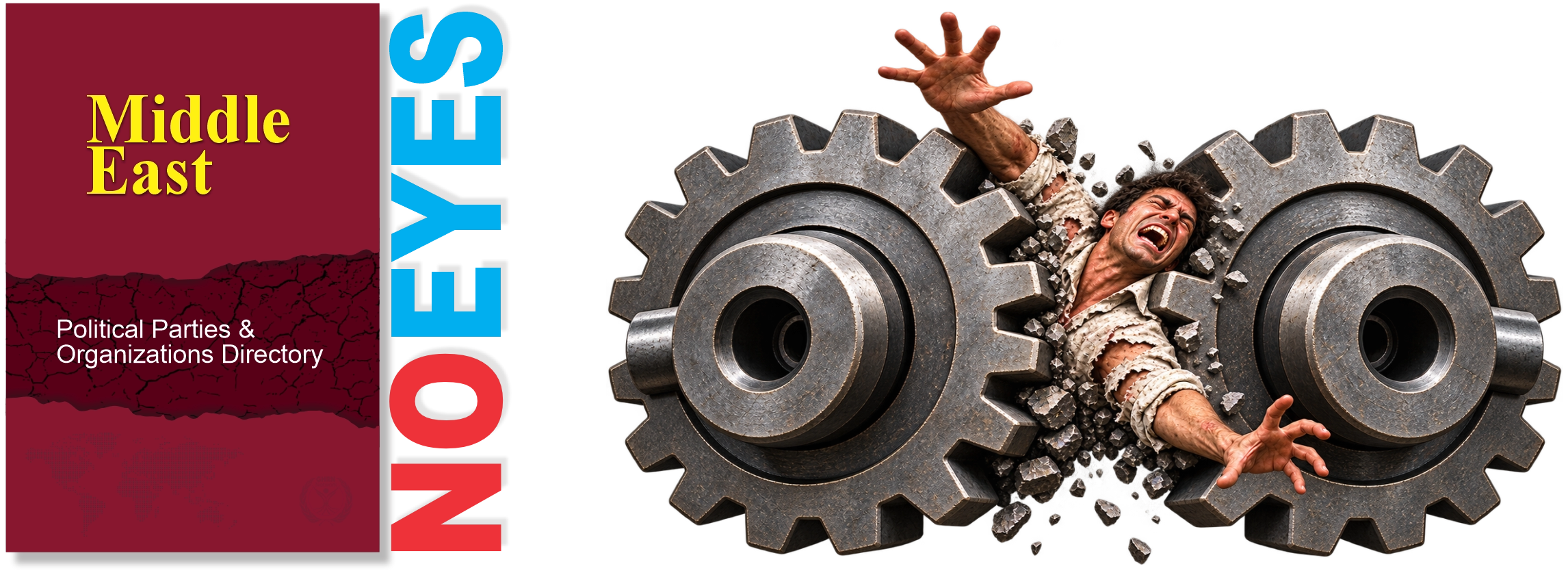
An account of the unequal struggle between the pen and power, the exposure of systemic corruption, the concentration of wealth, civil protest, and the contradiction between democratic rhetoric and the reality of oppression.
WE AGAINST POWER:UNARMED PENS ON AN UNEQUAL BATTLEFIELD
Our team stands committed to uncovering the truth, exposing systematic crimes, verifying facts, and bringing to light what remains concealed within the shadows of power. We pursue this mission through independent, direct, fearless, and uncompromising speech and writing, refusing to surrender to threats, bribery, censorship, or political expediency.
We stand on an unequal battlefield. On one side are our activists, armed only with pens, words, ideas, and truth. On the other stand powerful political, security, and economic structures equipped with sophisticated weaponry, vast intelligence apparatuses, networks of influence, and enormous financial resources.
This struggle represents a confrontation between two worlds: one that demands freedom and another that regards freedom as a threat to its monopoly on power.
Our voices belong to people who seek neither exclusive privileges nor the wealth of their nations for themselves, and who have no intention of replacing one form of tyranny with another.
OUR DEMANDS ARE CLEAR:
freedom, democracy, secularism, human dignity, human rights, social justice, and the equitable distribution of wealth throughout society.
We believe none of these values can be achieved through silence in the face of oppression and injustice.
Freedom begins when people overcome fear, raise their voices in protest, and demand accountability from those in power.
Our pen is an instrument of truth, our voice is an expression of protest, and our collective outcry demands accountability from every official who considers themselves above the will and rights of the people.
AN UPSIDE-DOWN WORLD:FROM OIL FORTUNES TO GOLD BARS HIDDEN IN THE CHAMBERS OF POWER
We speak of societies where the distance between those in power and ordinary citizens is measured not
merely by the walls of palaces and government buildings, but by the gulf separating an impoverished family's empty table from the bank accounts of the powerful and wealthy.
In one corner of an oil-rich city, enormous fortunes generated from natural resources accumulate within a narrow circle of influential individuals and holders of exclusive privileges. In that same city, families struggle with poverty and deprivation as they attempt to secure food, medicine, housing, and the most basic necessities of life.
On one side of the street, a child grows up in poverty. On the other, towers, palaces, and fortunes rise, raising serious questions about corruption, favoritism, and the misuse of public resources.
But this is only part of the story.
Elsewhere in the world, even in capitals that portray themselves as symbols of democracy, transparency, and the rule of law, cases involving financial corruption, bribery, and abuse of public office have demonstrated that power and wealth can be vulnerable to corruption under any political system.
This is the same upside-down world in which millions of dollars in oil revenues flow into the bank accounts of a narrow circle of powerful individuals on one continent, while on another continent millions of dollars in cash, gold bars, and questionable assets are discovered in the corner of a room, residence, or office belonging to a government official.
Corruption can hide behind a minister's desk, in a politician's office, within the dealings of a government employee, or inside complex economic and security networks.
An official title, an elegant suit, a government insignia, an identification badge, or a position within intelligence and security institutions guarantees neither integrity nor honesty.
Where political power, financial resources, and administrative secrecy intersect, the absence of transparency and independent oversight can create opportunities for abuses of authority and concealed conflicts of interest.
In such arrangements, governments change, political factions alternate, and new faces occupy seats of power. Yet networks of influence and economic interests may remain firmly entrenched.
No political, administrative, military, intelligence, or security official should be permitted to use their position as a shield against truth, public scrutiny, or accountability concerning the origins of their wealth and their conduct in office.
The wealth of nations belongs to their people, not to the private estates of those in power. Public resources must serve social welfare, education, healthcare, development, and future generations, rather than becoming instruments for accumulating privileges within a narrow circle.
FREEDOM MOVEMENTS EXCLUDED FROM THE LIST:
Victims of the Civilized World’s Arbitrary Boundaries
The following section introduces political parties, civil society organizations, independent media, and freedom-oriented movements across the Middle East that support democracy, secularism, freedom of expression, human rights, and the unrestricted political participation of citizens.
The selection criterion for political parties and organizations in this collection is the absence of any history of armed activity or a military wing since their establishment.
Accordingly, certain political parties and movements from conflict-scarred countries such as Syria, Yemen, Palestine, and Iran have not been included.
Their exclusion, however, does not signify a rejection of their aspirations for freedom, a blanket condemnation of their historical struggles, or a disregard for the repressive conditions under which some of these political movements emerged.
This limitation reflects only the selection criteria of this collection. Against the bloody history of the Middle East, however, the criterion itself becomes a symbol of the distance between political classifications and the lived realities of nations.
In countries where peaceful protests have been met with arrests, torture, and deadly violence, the history of political parties and movements cannot be reduced to a single administrative label.
Some movements emerged through civilian political activity, others faced prohibition and repression, while still others followed different paths amid wars and political crises.
How easy it is to praise peaceful resistance from behind secure desks and leather chairs when no bullet has ever been aimed at the child of the person offering that praise.
Excluding a political movement from a limited directory must never become a means of erasing history, disregarding victims' suffering, or dismissing the aspirations for freedom of people who have endured profoundly difficult and unequal conditions.
IN THE SLAUGHTERHOUSE OF THE MIDDLE EAST:
When Power Speaks Through Gunpowder and Blood
The Middle East carries a long and painful history of war, political repression, torture, imprisonment, displacement, and widespread human rights violations.
In Iran, the suppression of protests, detention of political and civil society activists, and extensive use of capital punishment have been prominent concerns in human rights reporting on the conduct of the Islamic Republic.
In Syria under Bashar al-Assad, the suppression of protests, arbitrary detention, torture, and widespread violence, compounded by years of war, produced devastating humanitarian consequences.
In Yemen and the Palestinian territories, prolonged wars, political crises, and violence have inflicted profound suffering on civilian populations.
In such places, freedom is no longer merely a topic for academic lectures or diplomatic conferences.
Freedom is inseparable from security, survival, the future, and human dignity.
A mother who has lost her child finds no consolation in ceremonial expressions of concern. A father whose home and family's security have been destroyed cannot rebuild his life through empty promises.
A child growing up beneath the shadow of war discovers the meaning of freedom in safety and the possibility of an ordinary life, long before encountering the concept in a textbook.
When a dictator writes the language of dialogue in gunpowder and blood, the human right to life and security must not disappear beneath political calculations and expediency.
A society deprived of the freedom to protest, where citizens live under constant threat, cannot achieve justice merely by being instructed to remain silent and endure.
People protesting for their rights must not be abandoned in the face of repressive institutions and then expected to pay for the inaction of others with their lives and liberty.
EXPEDIENT CONSCIENCES AND SHOWCASE DEMOCRACIES
Let us speak this time not in the cold language of diplomacy or through exhausted political courtesies, but with a voice born of anger, grief, and human conscience.
We address those occupying luxurious leather chairs in international organizations, NATO commanders, and well-dressed politicians who speak of freedom, democracy, and human dignity from Washington, Brussels, and European capitals.
In magnificent halls, human rights charters are recited. Speakers solemnly invoke justice and international responsibility. Cameras illuminate the room, impressive words fill the air, and audiences applaud.
Then the conference ends.
The lights in the hall go out.
Yet somewhere else in the world, the light in another home has also gone out forever, a home in which the voice of a beloved child will never again be heard.
This is the profound divide between diplomatic grandeur and the lived reality of victims.
On one side of the world, economic and security agreements are negotiated meticulously, strategic interests are discussed, and political powers compete for influence within the international order.
On the other side are families deprived of even the most basic guarantees of safety and justice.
Democracy becomes a showcase performance when universal values are celebrated in speeches while political and economic interests overshadow the fate of vulnerable human beings in actual decisions.
This contradiction erodes the credibility of human rights rhetoric among populations that have repeatedly heard promises of support.
THE POLITICAL MARKETPLACE:
Oil, Weapons, and Hidden Interests
In international relations, energy resources, arms contracts, economic interests, and geopolitical competition are among the forces shaping government decisions.
When these interests take precedence over protecting vulnerable people, foreign policy becomes an arena of contradiction between proclaimed moral principles and calculations of power.
In a world where multibillion-dollar arms deals are negotiated rapidly while the suffering of victims of repression encounters delay, political disagreement, and repeated promises, the distance between official priorities and human needs becomes increasingly apparent.
Major corporations, wealthy investors, lobbying networks, and influential economic actors possess extensive resources to advance their interests, resources unavailable to political prisoners, grieving families, and disadvantaged communities.
On one side of the world, fortunes derived from oil and natural resources circulate through powerful economic networks. On the other, immense capital flows through security and defense industries.
Caught between these interests are human beings whose share of this wealth and power is sometimes little more than war, displacement, poverty, and insecurity.
When profit and power become the common language of politics, the voices of victims are drowned out by contracts, transactions, and strategic rivalries.
Under such circumstances, even justice and human rights risk becoming instruments of political prestige, words repeated in public but insufficiently reflected in people's lives.
PAPER CONDEMNATIONS:
Elegies Recited After Death
So many statements have begun with the words, “We are deeply concerned.” So many meetings have concluded with declarations of “strong condemnation.” And so many families have continued waiting for news of their loved ones long after those statements were published.
- A statement cannot shield a child from a missile.
- A condemnation cannot remove the chains of a prisoner.
- A speech cannot return a murdered young person to their mother's arms.
- A resolution that produces no effective action cannot, by itself, prevent further repression.
For a family that has lost a loved one, grand political declarations cannot replace justice, truth-seeking, or accountability.
Justice that arrives only after the victim's death is, for those left behind, less an act of justice than a belated elegy.
The credibility of international organizations and governments claiming to defend human rights cannot be measured solely by their founding charters, magnificent buildings, number of employees, or annual budgets.
Their true credibility is reflected in their commitment to obligations, transparency of decisions, accountability, and the observable outcomes of their actions.
Repeated condemnations without effective follow-through risk reducing the language of human rights to an administrative ceremony, one whose failures are paid for by victims of repression with their lives.
SILENCE IS NOT THE PATH TO CIVIL RESISTANCE OR FREEDOM
Silence is neither a form of meaningful civil resistance nor a pathway to building a free, secular, and democratic society.
No nation has made entrenched authoritarian structures accountable simply by remaining silent in the face of oppression, corruption, discrimination, and monopolized power.
Silence does not dismantle the barriers of repression, return public wealth to its rightful owners, or compel the powerful to take responsibility for their conduct.
Silence in the face of injustice displaces protest and deprives society of opportunities to demand change.
When citizens are denied the freedom to express dissent, those in power become further removed from one of the essential mechanisms of public oversight.
It is the collective voice of civil protest, resistance to injustice, exposure of the truth, and sustained demands for fundamental rights that can open the way toward freedom, democracy, secularism, human rights, and an equitable distribution of wealth throughout society.
Civil protest is the language of a society that refuses to surrender to oppression.
The cry for freedom is the voice of people who refuse to allow their future to be decided behind closed doors without their participation.
Demanding accountability is the right of citizens who hold political authorities responsible for their decisions, conduct, and consequences.
No official, regardless of position within political, governmental, administrative, military, security, or economic structures, should consider themselves beyond public scrutiny and accountability.
Through civil protests, peaceful assemblies, the documented exposure of corruption, freedom of expression, and demands for transparency, citizens can bring those in power before public opinion and legitimate accountability mechanisms.
Government officials, security personnel, economic administrators, and anyone entrusted with public authority or resources must answer for the consequences of their decisions and actions.
No title, office, rank, uniform, or security position should erect a barrier between a person exercising power and the public's right to demand truth and justice.
We do not regard silence as the pathway to freedom.
We believe in the power of the pen, the voice of protest, public awareness, and civil resistance, because a free society is built by citizens who refuse to surrender their right to question, protest, criticize, and demand answers.
Freedom cannot flourish through silence in the face of oppression.
Democracy cannot emerge from the monopolization of power.
Secularism cannot be realized through the imposition of a state ideology.
Human rights cannot be protected by depriving citizens of the right to protest.
And an equitable distribution of wealth cannot be achieved by concealing public resources within patronage networks and opaque bank accounts.
Protest is the beginning of holding power accountable; the collective outcry is the voice demanding justice; and informed public participation forms the foundation of a free, secular, democratic society grounded in human rights and the equitable distribution of wealth.
NAMES EXCLUDED, TRUTHS THAT CANNOT BE ERASED
In compiling this directory, we have selected political parties and movements that, according to the established criteria, have no history of armed activity.
This decision defines only the research scope and selection method of this collection.
Parties and movements that have been associated with military activities or armed struggles at some point in their history have not been included. Yet their histories, the circumstances surrounding their emergence, and the experiences of the people they claim to represent do not disappear through such exclusion.
Political movements across the Middle East have not emerged under identical historical conditions.
Some developed through conventional party politics and civil society activity, others encountered prohibition and repression, while still others followed different paths amid wars and political crises.
Understanding these histories requires careful examination of each movement's circumstances, objectives, and conduct.
We reject attempts to conceal the complexity of oppressed peoples' histories beneath simplistic classifications and sweeping labels.
Just as the pursuit of freedom must never be used to justify violence against civilians, a history of resistance under repression must not, without independent historical examination, become grounds for dismissing every legitimate demand associated with a political movement.
A political party's name may be removed from a list, but the history of a nation, the suffering of victims, and the aspirations of its people for freedom cannot be erased from the world's memory.
THE SOLITARY PENS AGAINST THE WALLS OF TYRANNY
The following section introduces non-armed political parties, civil society organizations, independent media outlets, and information platforms working to advance freedom of expression, public awareness, democracy, and human rights.
These organizations do not operate under identical circumstances.
For a journalist in a free society, publishing a critical report may be a routine professional activity. Under a repressive system, the same report may result in threats, censorship, imprisonment, or deprivation.
A pen is a pen in both countries, but the price of writing the truth is not the same.
In one society, a sentence may initiate a public discussion. In another, the very same sentence may trigger a security investigation.
A power structure that fears the publication of truth attempts to contain public thought through walls, prisons, and threats.
Yet ideas are not possessions that can be locked forever in a hidden bank account.
Truth can be censored, but censorship cannot alter reality.
The pen may be defenseless against a weapon, but a power structure that resorts to prisons and threats to silence a writer reveals just how deeply it fears the influence of that pen.
HISTORY WILL PUT THE LEATHER CHAIRS ON TRIAL, TOO
We speak of human rights because human dignity must not depend on nationality, economic class, religion, or political position.
We defend democracy because political power must derive its legitimacy from the people and remain accountable to them.
We advocate secularism because freedom of thought and equal citizenship must never be sacrificed to the ideological monopoly of the state.
We defend social justice and the equitable distribution of wealth because a nation's resources must not become the exclusive property of closed circles of power.
We demand truth-seeking and the exposure of corruption because no political, administrative, military, or intelligence official should stand beyond scrutiny and accountability.
And we defend freedom of the press and the right to civil protest because a society deprived of the ability to speak truth and challenge injustice loses two of its most fundamental instruments against corruption and tyranny.
TO THOSE WHO OCCUPY POSITIONS OF POWER AND SPEAK OF FREEDOM, SECURITY, AND JUSTICE, ONE HISTORICAL REALITY REMAINS UNDENIABLE:
Rulers and decision-makers are not remembered solely for their official titles and magnificent ceremonies.
Their actions, decisions, and the consequences imposed upon human lives also become part of the historical record.
History will record the names of those who ordered repression.
It will remember victims, grieving families, and generations that paid the price for demanding freedom.
And the decisions of those who knew about crises and held positions of authority over how to respond will not be immune from historical judgment.
Magnificent buildings, leather chairs, official uniforms, government decorations, and bank accounts overflowing with wealth cannot substitute for accountability.
History's gravest judgment is not reserved solely for those who openly ordered violence. It also extends to institutions that knew the truth, possessed the power to make decisions, and concealed their responsibilities behind walls of political expediency.
We will not lay down our pens on this unequal battlefield, nor will we silence our voices of protest.
Not in the face of accumulated fortunes, not before immense security apparatuses, not under threats from the powerful, and not amid the indifference of those who invoke justice only in name.
We believe that the path toward a free, democratic, and secular society lies through public awareness, civil protest, civic participation, and holding those in power accountable.
Truth cannot be imprisoned forever, just as gold cannot purchase a conscience, weapons cannot manufacture legitimacy, and paper condemnations cannot erase the blood of victims from the memory of history.
Freedom is not won through silence. It begins with the voices of people who refuse to remain quiet in the face of oppression, corruption, discrimination, and injustice; people who use the pen, protest, and civil resistance to hold the powerful accountable and work toward a free, secular, democratic society founded on human rights and the equitable distribution of wealth.