The Deception of “Carrot-and-Stick” Diplomacy: How Foreign Leverage Brought the Wheels of Iran’s Revolution to a Halt
The endurance of the Islamic Republic of Iran cannot be explained by domestic repression alone. Its survival must be examined at the intersection of three forces: a deeply institutionalized apparatus of repression inside Iran, a regional network developed over decades to project Iranian state power beyond its borders, and the policies of foreign governments that have alternated between containment, sanctions, military pressure, negotiation and incentives. For Iranians seeking fundamental political change, this distinction matters. A foreign government may want Tehran weakened, contained or compelled to change its behavior without necessarily sharing the objective of Iranian protesters who seek the dissolution of the political system itself.
Systematic repression as an instrument of survival
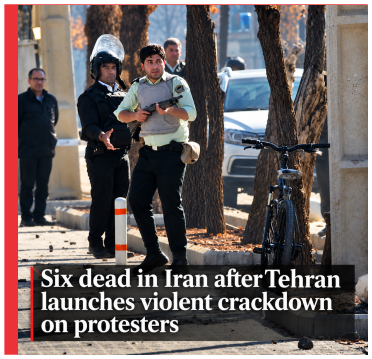
The human-rights record of the Islamic Republic is not based merely on allegations by political opponents. The United Nations Independent International Fact-Finding Mission on Iran concluded in its investigation of the repression surrounding the Woman, Life, Freedom movement that gross violations included murder, imprisonment, torture, rape and other forms of sexual violence, persecution, enforced disappearance and other inhumane acts. The Mission found that many of these violations amounted to crimes against humanity committed as part of a widespread and systematic attack directed against women, girls and others supporting human rights. Its September 2024 update cited a credible figure of 551 people killed, including as many as 49 women and 68 children, in connection with the 2022 protests and their repression.
This pattern did not end with the Woman, Life, Freedom uprising. After nationwide protests began again on December 28, 2025, UN human-rights mechanisms received allegations of widespread arbitrary arrests and detention, enforced disappearance, torture, cruel or degrading treatment and serious violations of due-process rights. On January 23, 2026, the UN Human Rights Council adopted a resolution specifically addressing the repression of the nationwide protests that had begun on December 28, 2025. A later May 27, 2026 communication by UN experts again recorded allegations of widespread arbitrary detention, enforced disappearance and torture associated with those protests.
These findings matter politically because repression in Iran cannot reasonably be treated as an occasional malfunction of government. It is intertwined with the state’s ability to preserve itself. When political participation, freedom of assembly, independent journalism and organized opposition are restricted, coercive power becomes one of the principal mechanisms through which the political order survives.
The regional architecture behind Tehran’s power
The Islamic Republic also spent decades constructing a security architecture beyond Iran’s borders. The Islamic Revolutionary Guard Corps, particularly the Quds Force, became central to Tehran’s external strategy, while Iran developed relationships with armed organizations and political actors in Lebanon, Iraq, Syria, Yemen and the Palestinian territories.
A Congressional Research Service report on Iran documents Tehran’s longstanding support for the Houthi movement in Yemen, including material support and the provision of missile and unmanned-system capabilities. The 2026 Annual Threat Assessment of the U.S. Intelligence Community likewise identifies Iran-aligned actors including Lebanese Hezbollah, the Houthis and Iraqi Shia militias as continuing security concerns despite major degradation of Tehran’s regional capabilities.
This external network helps explain why Iran policy has rarely been only about Iran. Western governments have had to calculate nuclear proliferation, Israel’s security, Persian Gulf stability, Iraq, Syria, Lebanon, Yemen, maritime trade, energy markets, terrorism and the possibility of a wider regional war. The Iranian people’s struggle for political change therefore operates inside a much larger geopolitical contest in which foreign states inevitably pursue interests of their own.
The real history of “Carrot and Stick”
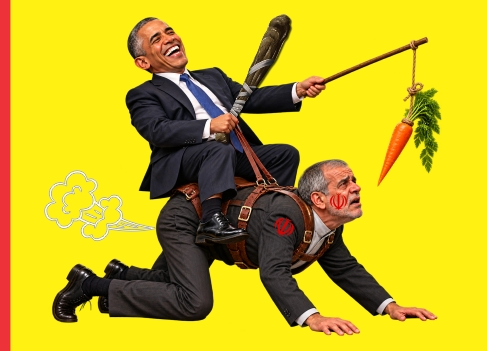
The strategy commonly called “Carrot and Stick” combines pressure with inducements: impose sufficient political, economic or military costs to change an adversary’s calculations while simultaneously providing a pathway to benefits if the adversary changes its behavior.
It would be historically inaccurate to say that Barack Obama invented this strategy toward Iran. An official U.S. State Department fact sheet from June 16, 2008, during the administration of President George W. Bush, explicitly described the P5+1 approach toward Iran as a “dual-track strategy”: negotiations and incentives would be offered if Iran suspended proliferation-sensitive nuclear activities, while targeted sanctions and pressure would simultaneously be increased.
The incentives were substantial. Another official 2008 State Department document detailing the P5+1 incentives package proposed improved political relations, direct dialogue, nuclear-fuel guarantees, civil-aviation cooperation, possible removal of certain export restrictions, assistance with telecommunications infrastructure, economic and social development cooperation, educational programs and other forms of engagement.
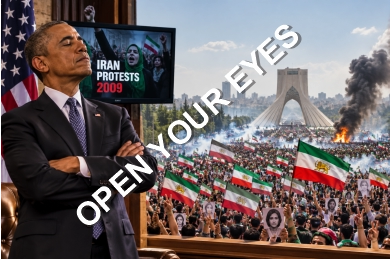
What changed under the Obama administration was not the invention of the concept but its development into an explicit and central framework of U.S. Iran policy. In an official 2013 State Department description of U.S. policy toward Iran, the administration stated: “Since this Administration took office in 2009, we have pursued a dual-track policy.” The document described the two tracks clearly: active pursuit of a diplomatic solution through the P5+1 while simultaneously increasing pressure and constructing what Washington described as the toughest and most comprehensive sanctions imposed on Iran to that point.
A second official State Department statement in 2013 was even more explicit, describing the strategy as the “dual track policy of engagement and pressure.” U.S. officials explained that diplomatic engagement was preferred but that Washington had concluded diplomacy would not work without substantial pressure.
The evidence therefore establishes an important distinction: Obama did not originate carrot-and-stick diplomacy toward Iran, but his administration institutionalized and intensified a dual-track strategy of engagement and pressure and made it a defining component of U.S. Iran policy.
Sanctions, negotiations and the JCPOA
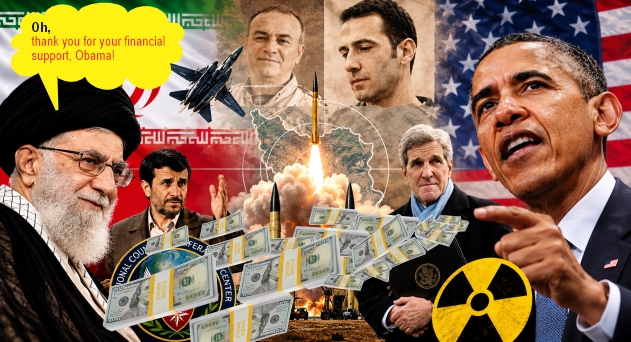
The Obama administration subsequently constructed a broader international sanctions coalition while keeping negotiations open. In an archived White House briefing on July 14, 2015, administration officials described the sequence directly: Washington initially pursued diplomacy; when that failed to produce the required result, the United States moved toward severe sanctions while continuing to make clear that a diplomatic resolution remained preferable.
That process ultimately produced the Joint Comprehensive Plan of Action, or JCPOA. Under the agreement, Iran accepted restrictions and monitoring of its nuclear activities in exchange for nuclear-related sanctions relief. In his July 14, 2015 statement on the agreement, Obama explained that sanctions relief would be phased and tied to Iran completing specified nuclear steps, while sanctions could return if Iran violated the agreement. He described the structure in terms of both incentives for compliance and consequences for violation.
On JCPOA Adoption Day in October 2015, the White House stated that Iran was required to remove thousands of centrifuges, reduce its enriched-uranium stockpile from roughly 12,000 kilograms to 300 kilograms, and alter the Arak heavy-water reactor before receiving the specified nuclear-related sanctions relief after IAEA verification.
This history demonstrates precisely why the interests of a foreign state and those of a revolutionary movement must not automatically be treated as identical. Washington’s objective was to change specific Iranian state behavior, particularly the nuclear program. For Iranian protesters demanding the end of the Islamic Republic, the objective is fundamentally different: changing the political system itself.
December 2025: the street again challenges the state
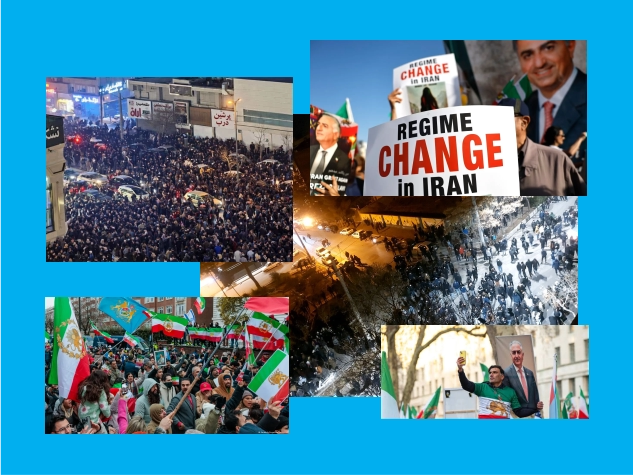
Nationwide protests beginning on December 28, 2025 again confronted the Islamic Republic with a serious internal challenge. The scale of the repression was sufficient for the UN Human Rights Council to convene a special session and adopt a resolution addressing the crackdown in January 2026. UN experts subsequently documented allegations involving arbitrary arrests, disappearances and torture.
As the crisis intensified, the United States became increasingly important to the expectations of protesters. On January 13, 2026, President Donald Trump publicly urged Iranians to continue protesting and to take control of their institutions, adding that “HELP IS ON ITS WAY.” Reuters documented the statement and reported that Trump had also canceled meetings with Iranian officials until the killing of protesters stopped. On the same day, Reuters reported Trump warning that the United States would take “very strong action” if Iranian authorities began hanging protesters.
These statements inevitably changed expectations. When the president of the world’s most powerful military tells protesters confronting an armed authoritarian government that help is coming, some participants will naturally interpret the statement as more than rhetorical solidarity. Expectations of outside intervention become part of the movement’s strategic calculation.
February 28: “Stay at home” and wait for the final battle
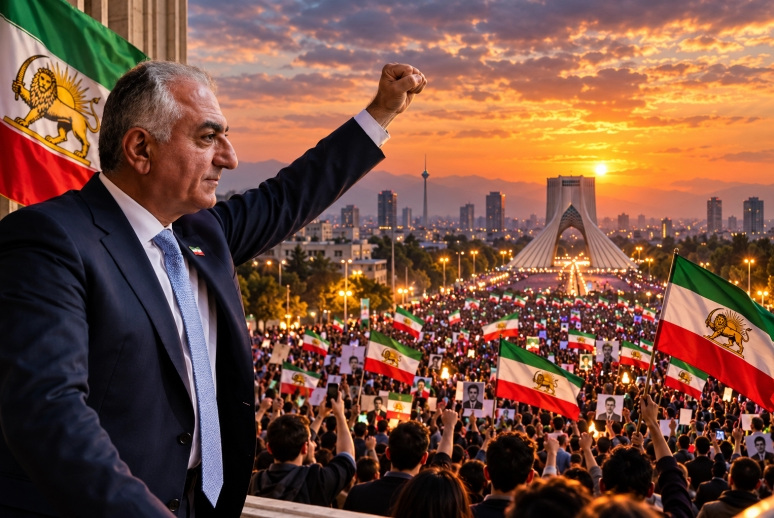
The equation changed dramatically on February 28, 2026, when major U.S. and Israeli military operations against Iran began. Reuters reported widespread explosions, fear and uncertainty across Iran while Trump framed the operation as an opportunity for Iranians to overthrow their rulers.
At precisely this critical stage, another politically consequential message emerged. Cameron Khansarinia, chief of staff to Reza Pahlavi, told Reuters on February 28 that Pahlavi had instructed Iranians “to stay at home” for the time being. According to Khansarinia, when the time came for the “final battle” and the return to the streets, Pahlavi would call upon them to act. He also said that the assistance long promised to Iranians had finally arrived and specifically credited Trump with acting.
The intentions behind such a message can be debated. Its strategic significance cannot.
For a mass movement confronting a coercive state, an instruction to withdraw temporarily from the streets can affect momentum, psychology and expectations. Revolutionary energy cannot necessarily be placed in storage and reactivated at the same intensity at a later date.
The mechanics of revolutionary momentum
A mass uprising resembles, in one important respect, a heavy vehicle accelerating down a steep road. Once it has acquired speed and momentum, stopping it fundamentally changes the equation. The road may remain unchanged and the destination may still be visible, but restoring the previous momentum requires additional time and energy.
Political movements behave similarly. Their force does not come only from the number of people who dislike a government. Momentum develops when fear is broken collectively, individuals see thousands of others taking the same risk, state institutions experience continuous pressure, security personnel begin confronting exhaustion and uncertainty, and society starts to believe that fundamental change is no longer theoretical but possible.
Interrupting this process carries consequences. The government receives time to reorganize. Security services can identify participants, rebuild command structures, increase surveillance, conduct arrests and exploit divisions. Protesters, meanwhile, can lose confidence, leave the country, return to private life or conclude that the promised decisive moment has passed.
From my perspective, this is one of the central lessons of Iran’s recent experience: a revolutionary movement must be extremely cautious about surrendering its momentum in expectation that an external military or political actor will complete the task on its behalf.
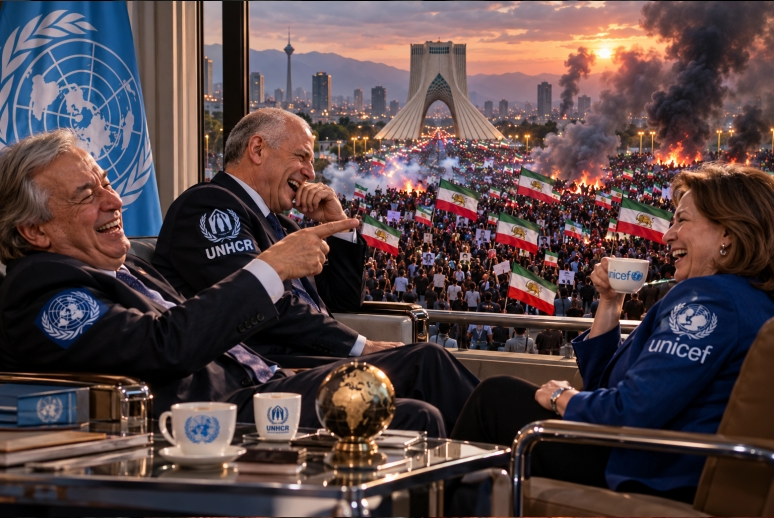
When the Iranian street becomes the “stick”
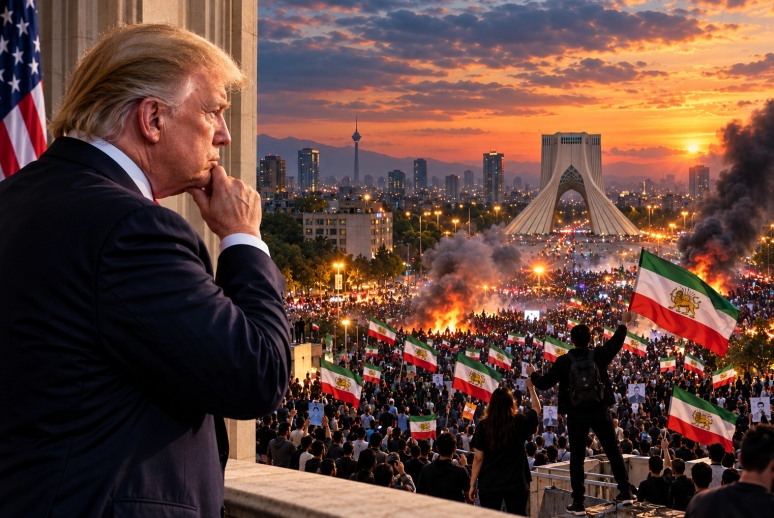
This brings us back to carrot-and-stick diplomacy. If the objective of a foreign government is to change Tehran’s behavior rather than necessarily abolish the Islamic Republic, a powerful domestic uprising creates an additional source of pressure. Tehran can simultaneously face sanctions, diplomatic isolation, military threats and the possibility that domestic unrest may threaten the survival of the political order.
The existence of such pressure strengthens the bargaining position of Tehran’s adversaries. The regime can be presented, explicitly or implicitly, with alternatives: modify nuclear behavior, alter regional policies, negotiate, provide concessions, or face escalating external and internal pressure.
This does not require a conspiracy theory or secret agreement. It follows from the ordinary logic of international relations: states use available leverage to advance their national interests.
The historical record of U.S.-Iran diplomacy itself demonstrates this. The 2008 P5+1 proposal combined incentives with sanctions. The Obama administration combined engagement with pressure. The JCPOA exchanged verified nuclear restrictions for sanctions relief. Later administrations changed the mixture of pressure and negotiation, but the underlying principle remained recognizable: pressure can create leverage, and leverage can be converted into concessions.
The danger for the Iranian people arises when their own revolutionary movement becomes one of those bargaining instruments.
Foreign support is an asset; foreign dependency is a vulnerability
None of this means that Iranian opposition movements should reject international support. Foreign governments can provide diplomatic backing, secure communications, intelligence about repression, sanctions against human-rights violators, disruption of illicit financial networks, international media exposure and pressure on governments or companies that materially assist Tehran. International action can substantially change the strategic environment in which an opposition movement operates.
But there is a fundamental difference between using foreign assistance and outsourcing the direction of a revolution.
The timing of mobilization, withdrawal, escalation, political organization and transition must ultimately remain an Iranian decision. A government in Washington, Jerusalem, London, Paris or Berlin is constitutionally and politically obligated to pursue its own national interests. It cannot be expected to subordinate those interests permanently to the objectives of an Iranian revolutionary movement.
Today’s strategic alignment can become tomorrow’s negotiation. A military confrontation can be followed by diplomacy. Sanctions can be imposed and subsequently lifted. A demand described as non-negotiable can later become part of a negotiated settlement. That is how states operate.
A nation seeking freedom cannot build its entire revolutionary strategy around the assumption that another state’s interests will remain permanently identical to its own.
Independence of decision at the decisive moment
For a movement whose stated objective is the dissolution of the Islamic Republic, strategic clarity is therefore essential. The movement must know precisely what it seeks, maintain independent decision-making, recognize attempts to fragment its momentum, avoid excessive dependence on promised foreign intervention and prepare politically and organizationally for moments when the state’s coercive capacity is genuinely weakened.
This also requires rapid recognition of disinformation, political confusion and competing instructions during moments of crisis. Advice may come from foreign governments, political leaders, opposition organizations, influential individuals or even trusted personal networks. Advice should be evaluated, not automatically obeyed. In a decisive struggle, independence of action does not mean isolation; it means retaining final authority over one's own strategy.
Political leaders carry a particularly heavy responsibility in such circumstances. A statement issued thousands of miles away can influence hundreds of thousands of people inside Iran. Calls to remain home, promises of imminent foreign intervention, declarations that “help is on its way,” or assurances of a future “final battle” are therefore not ordinary political rhetoric. Their consequences should be examined historically and strategically regardless of who issued them.
The final lesson
The Islamic Republic has had more than four decades to construct security, intelligence, ideological, financial and regional mechanisms designed to preserve itself. The UN Fact-Finding Mission has documented the severity of the internal repression associated with that survival structure; U.S. intelligence assessments document the continuing security implications of Iran and its aligned networks; and official American diplomatic records from 2008, 2013 and 2015 demonstrate how pressure and incentives have repeatedly been combined to influence Tehran’s behavior.
The lesson for Iranian political movements should therefore be clear. Foreign powers are not permanent allies of any national revolution; they have permanent strategic interests. When those interests coincide with the liberation of Iran, that alignment can and should be understood and used. But the authority to determine when to mobilize, when to resist, when to reorganize and what constitutes victory must remain in Iranian hands.
Carrot-and-stick diplomacy may be useful to foreign governments seeking concessions from Tehran. The Iranian people must never permit themselves to become the “stick” in somebody else’s diplomatic strategy. A population that pays for political change with imprisonment, torture, exile and blood must retain ownership of the decisions that determine its future. Iran’s freedom must never become a bargaining chip on someone else’s negotiating table